
What Is the Notswolds? A Guide to England's Quietly Emerging Countryside
If you have started seeing the word "Notswolds" in the travel pages and wondered whether you missed the memo, you are not alone. It is a name that has gathered real momentum over the past couple of years, and it describes the countryside right on our doorstep. Here is what it means, where it is, and why people are beginning to make the trip.
What is the Notswolds?
The Notswolds is an informal name for the stretch of limestone countryside anchored by Rutland and reaching into the neighbouring counties, offering the stone villages, market towns and rolling farmland of the Cotswolds without the crowds or the prices. It is not an official designation and you will not find it on an Ordnance Survey map. It is a nickname that stuck, coined with a wink, and now used by everyone from national magazines to the people who live here.
The name does exactly what you would expect: it defines the region by what it is not. As Country Life put it in 2024, this is countryside with all the ambience of the Cotswolds without the price tag.
Where is the Notswolds?
The Notswolds sits in the centre of England, anchored by Rutland, the country's smallest county, and extending through the borderlands of Northamptonshire, Lincolnshire, Leicestershire, Nottinghamshire and Cambridgeshire.
The exact boundaries are cheerfully disputed, which is part of the charm of an unofficial region. What holds it together is the geology. The Notswolds lies north of the Cotswolds proper, along the same seam of oolitic limestone that built so much of England's most photographed architecture. That is why the villages here glow the same honey colour, and why places like Stamford are so often described among the finest stone towns in England.
The Welland Valley, where The Shambles sits, runs through the heart of it.
Why are people talking about it now?
The Notswolds has moved from local shorthand to national coverage in a short space of time. Country Life made the case for it in late 2024, Country & Town House returned to it in 2026 describing it as an emerging region and a quiet pretender to the Cotswolds crown, and there is now a dedicated platform at notswolds.com championing the area's independent makers, growers and businesses.
The appeal is straightforward. The Cotswolds are wonderful and extremely well known, which means coach parties, booked-out tables and prices to match. The Notswolds offers a similar landscape with more room to breathe, and the sense that you have found something rather than followed someone.
What is there to do in the Notswolds?
At its heart is Rutland Water, the largest reservoir in England, with around twenty-six miles of walking and cycling trails circling the shore, along with sailing, birdwatching and bike hire. Beyond it, the wider region has more than a thousand miles of footpaths and bridleways.
The market towns are the other draw: Stamford, Oakham, Uppingham, Oundle and Market Harborough, each with independent shops, galleries and places to eat that have not been flattened into sameness. Scattered between them are the great estates and houses, many still family-run and open to visitors, from Burghley to Kirby Hall, Deene Park and Rockingham Castle.
We have written more about all of this in our guide to the local area and our round-up of the best pubs nearby.
How do you get to the Notswolds?
It is far better connected than a hidden region has any right to be. London is around an hour away by train, with mainline stations at Stamford, Oakham, Peterborough and Grantham. By road you have the A1 and the A47 close at hand, and East Midlands, Luton and Stansted airports are all within reach. Once you are here, almost everything is a scenic drive down a country lane.
Where should you stay in the Notswolds?
The pleasure of this region is that it rewards a base rather than a checklist. Distances are short, the lanes are lovely, and the best days tend to be the ones where you set out with a rough plan and end up somewhere you had not heard of.
The Shambles sits in the Welland Valley, a short drive from Stamford and Rutland Water, in exactly the kind of stone village the Notswolds is named for. It is a two-bedroom, two-bathroom cottage with private parking, a private gym and secure bike storage, which makes it a practical base whether you are here to walk, cycle the Rutland Water circuit or simply eat well and do very little.
If you would like to stay in the Notswolds, we would love to have you.
Notswolds: the short version
Is the Notswolds a real place? Yes, though it is an informal name rather than an official region. It describes the limestone countryside centred on Rutland and its neighbouring counties.
Is Rutland in the Notswolds? Rutland is generally considered the heart of it.
What is the difference between the Cotswolds and the Notswolds? Both sit on the same limestone seam and share the stone villages and rolling countryside. The Notswolds lies further north, is far less visited and is considerably cheaper.
How far is the Notswolds from London? Around an hour by train to mainline stations including Stamford, Oakham, Peterborough and Grantham.
Where is the best base for exploring the Notswolds? Anywhere in the Welland Valley puts you within easy reach of Rutland Water, Stamford and the market towns, with the great houses and estates a short drive in most directions.
Where to Eat and Drink Near the Cottage: The Best Country Pubs Near Stamford
One of the quiet pleasures of a stay in this corner of the Welland Valley is how many genuinely good pubs sit within a short drive, from the village local you could almost walk to, right up to acclaimed dining rooms worth dressing up for. Here are the ones we send our guests to.
Start in the village
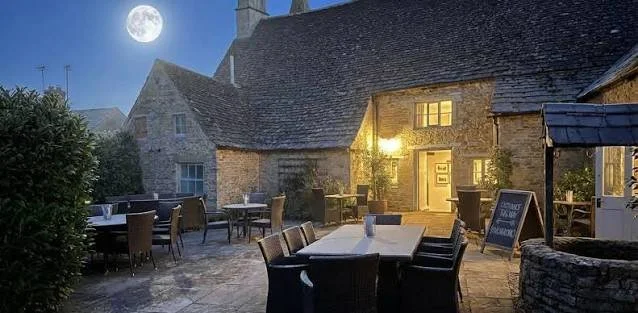
You do not have to go far at all. The Queen's Head in Bulwick is the village local: a quintessential Northamptonshire pub serving good food, wine and beer, with seating indoors by the fire and out in the garden when the weather obliges. It makes for the easiest possible first night, a short stroll or a two-minute drive with no motorway and no planning required.
A short drive through the villages
The lanes around here link a string of pretty stone villages, several with a pub worth seeking out.
The Falcon at Fotheringhay is more restaurant than pub, with a smart, seasonal menu and a garden made for long summer evenings. Fotheringhay itself rewards the trip: this small village was the birthplace of Richard III in 1452 and the place where Mary, Queen of Scots was executed in 1587, and the grassy castle mound above the river is still there to walk.
A few other village pubs are worth a look as you explore, among them the Royal Oak at Duddington, the Cross Keys at King's Cliffe and the White Swan at Woodnewton. Rural pubs keep their own hours and their menus change with the season, so it is always worth a quick call before you set out.
An evening in Stamford
Twenty minutes away, Stamford is one of the finest stone towns in England and a lovely place for supper.
The George is among the country's great old coaching inns, all panelled rooms and centuries of history, with everything from a relaxed garden room to proper tableside carving. The Bull & Swan, at the edge of the Burghley estate, dates back to the sixteenth century and is said once to have been a gentlemen's drinking club; today it is a warm spot for a good dinner. For something more relaxed, The Tobie Norris serves excellent pizza inside one of Stamford's oldest buildings, a wonderful warren of small rooms and open fires.
Worth the occasion
When you feel like marking the trip, point the car into Rutland. The Olive Branch at Clipsham, just off the A1, is one of the most decorated dining pubs in the region: an award-winning village pub with rooms that held a Michelin star for a decade from 2002, and has kept collecting honours since, including Best Hotel in the Midlands in the 2024 Good Hotel Guide. Book ahead, and give yourself the whole evening.
A few practical notes
The best country pubs get busy, particularly for Sunday lunch, so booking is wise and often essential. Opening days can shift with the season, so a quick phone call to confirm is never wasted. Most are an easy drive from the cottage, though if you plan to enjoy the wine list, a taxi home is the civilised choice.
Make The Shambles your base
Good food is one of the real joys of a few days here, and you are thoroughly spoilt for it. Settle in at the cottage, plan your evenings around a pub or two, and let the days unwind at their own pace. When you are ready to book, staying direct with us is always the best way.
A Local Guide to the Welland Valley: The Best Things to Do Near Stamford and Rutland
Tucked on the border of Northamptonshire and Rutland, where honey-coloured stone villages open onto quiet countryside and red kites wheel overhead, this is one of England's quietly rewarding corners. Within a short drive of The Shambles you will find Elizabethan mansions, a castle that has stood for nearly a thousand years, the largest reservoir in England and a good scattering of proper country pubs. If you are planning a few unhurried days here, this is where we would send you first.
Great houses and castles
The headline draw is the sheer concentration of history on the doorstep.
Burghley House, around twenty minutes away on the edge of Stamford, is one of the largest and grandest houses of the sixteenth century. It was built for William Cecil, Lord High Treasurer to Queen Elizabeth I, between 1555 and 1587, and his descendants live there still. Inside are eighteen state rooms and the dramatic painted Hell Staircase; outside, a deer park landscaped by Capability Brown that is free to wander, plus a woodland adventure playground that keeps younger visitors happy for hours. The house opens for most of the year, so it is worth checking ahead before you set off.
Kirby Hall is barely ten minutes from the cottage and quite unlike anywhere else. This roofless but magnificent Elizabethan mansion, now cared for by English Heritage, is celebrated for its strict symmetry, its intricate Renaissance carving and formal gardens that were once counted among the finest in England. It is an atmospheric, uncrowded place to spend a morning.
Deene Park has been the home of the Brudenell family since 1514. It was the seat of the Earls of Cardigan, one of whom led the Charge of the Light Brigade in 1854, and the gardens are a delight, complete with a lake and a parterre of topiary teapots. Opening days are limited through the season, so do book before you visit.
Rockingham Castle, built on the orders of William the Conqueror and lived in for almost a thousand years, completes the set, with sweeping views back across the Welland Valley.
The great outdoors
If you would rather be out in the fresh air, you are equally spoilt.
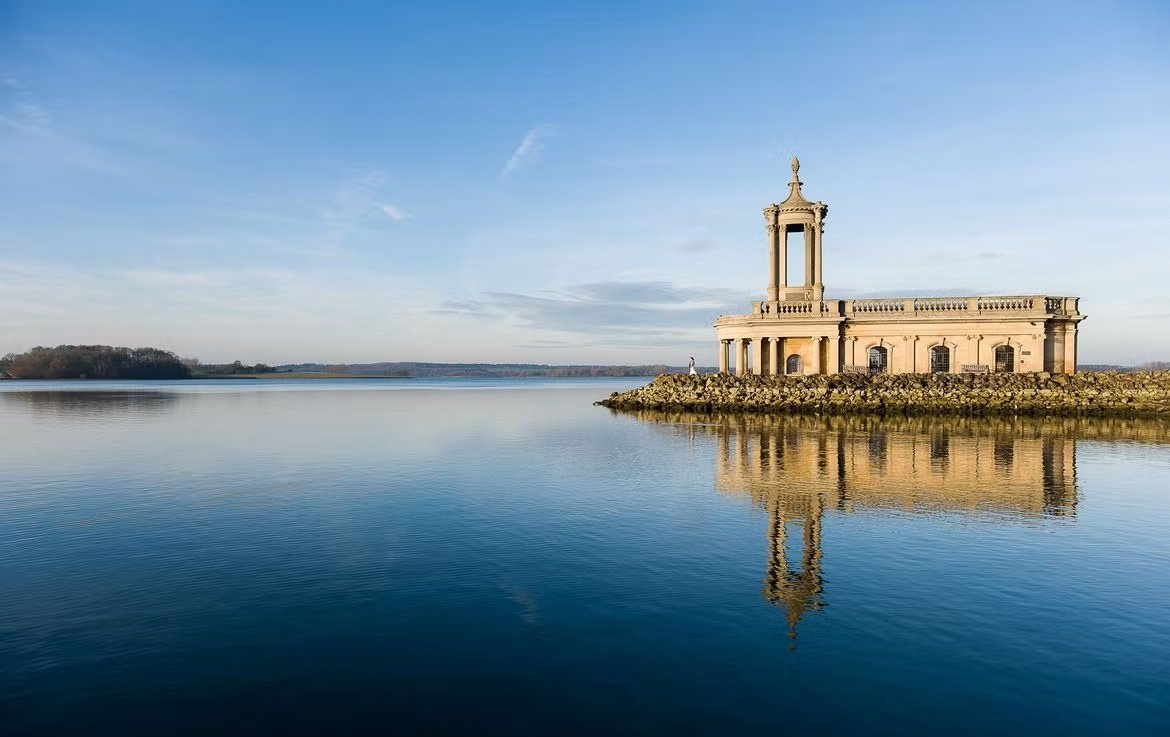
Rutland Water is the largest reservoir in England and a genuine day out in its own right. There is a long circular route for walking and cycling, bike hire if you have travelled light, sailing and watersports, a nature reserve at the western end for birdwatchers, and the much-photographed Normanton Church standing right at the water's edge.
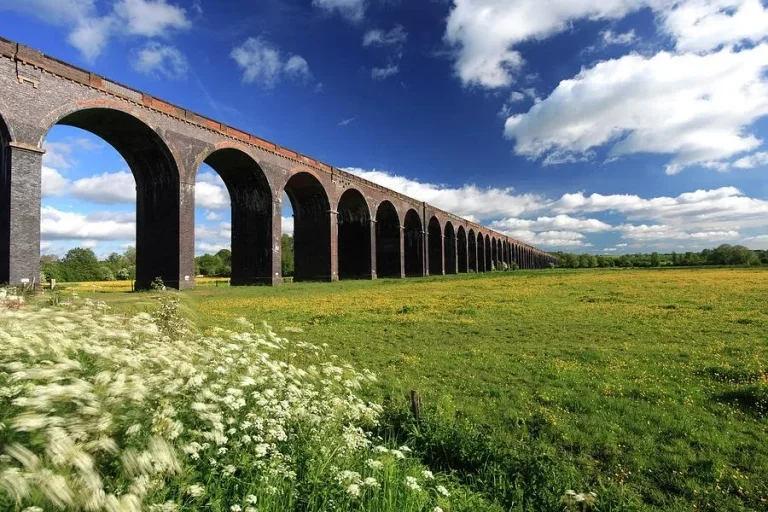
Closer to home, the Welland Viaduct at neighbouring Harringworth is a quiet marvel: the longest masonry viaduct across a valley in Britain, its eighty-two arches striding for more than three-quarters of a mile across the countryside. It is best appreciated on the circular walk from the village.
For woodland, Fineshade Wood is a surviving fragment of the ancient Rockingham Forest, with waymarked walking and cycling trails, bike hire and a café at Top Lodge. It is one of the most reliable places in the area to look up and see red kites overhead.
Market towns worth a wander
Stamford, about twenty minutes away, is regularly named one of the finest stone towns in England. Its Georgian limestone streets have stood in for period London on screen more than once, and there is a satisfying mix of independent shops, riverside walks, a Friday market and plenty of good spots for lunch.
Oundle, fifteen minutes in the other direction, is a handsome market town with independent shops, cafés and a farmers' market on the second Saturday of each month.
Over the Rutland border, Oakham and Uppingham are the county's two market towns. Oakham has a medieval castle famous for its extraordinary collection of ceremonial horseshoes, while Uppingham is small, pretty and full of traditional shops.
Where to eat and drink
You are never far from a good table. In the village itself, The Queen's Head in Bulwick is a quintessential Northamptonshire local, serving good food, wine and beer with both indoor and outdoor seating for whatever the weather does.
A little further afield, The Falcon at Fotheringhay is more restaurant than pub, with a smart menu and a garden for summer evenings. Fotheringhay is worth the trip in any case for its castle mound, the place where Mary, Queen of Scots met her end in 1587.
In Stamford you will find characterful old coaching inns such as The George and the Bull & Swan, and for a special occasion the celebrated Olive Branch at Clipsham is a short drive into Rutland.
Make The Shambles your base
Everything above sits within easy reach of the cottage, which makes it an ideal base for exploring at your own pace, whether you are here for the history, the walking or simply a quiet few days in beautiful countryside. When you arrive, we are always happy to share more of our own favourites.
When you are ready, booking direct with us is the best way to stay.